The Sound of an Alarm
A library of designed beeps, buzzers and sirens, built on analog and tube audio equipment for character that perfectly clean digital tones cannot match.
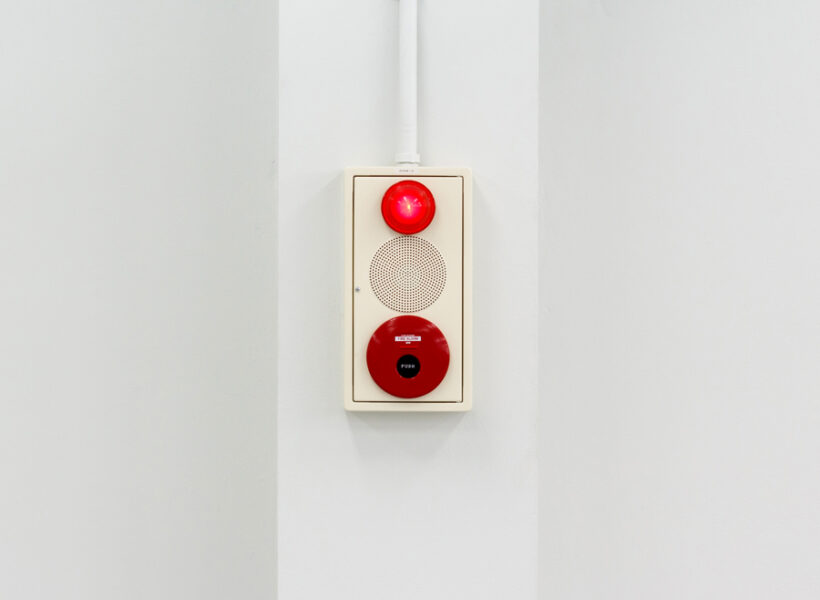
An alarm sound has one job: to be impossible to ignore. The interesting thing is how narrow the design space actually is. Move the pitch a little, slow the modulation a little, soften the attack a little, and the same alarm starts to read as a friendly notification instead of a real warning. The collection documented here is an attempt to fill that design space deliberately, with over a hundred long, un-looped alarms covering everything from subtle beeps to harsh buzzers and continuous sirens, plus a parallel construction kit of 100+ short, seamlessly looping building blocks for designers who want to dial in their own rate and rhythm.
Most of the sounds were generated through a chain of analog and tube audio equipment rather than rendered cleanly in software. The signal path introduces small imperfections, slow drifts and harmonic colour that give each alarm a more believable, lived-in quality, of the sort that real-world alarms acquire as their components age. The full set runs to over two hours of audio at 96 kHz / 24 bit, in stereo, totalling 4.4 GB.
The categories of alarm
-
Beeps
Short, repeating tones with a noticeable pause between each pulse, in the manner of a digital alarm clock or microwave timer. Coverage spans high, medium and low pitch, single tones and alternating tones, with rates from slow polite reminders to fast urgent warnings, and variants with constant tone, accelerating, decelerating, and pitch-modulated profiles.
-
Buzzers
Harsher pulsed alarms with a denser harmonic content than the clean beeps, including distorted and howling variants. Useful for old-school appliance alarms, intercoms, electrical fault warnings and the kind of unfriendly buzzers heard in industrial environments and game-show wrong-answer cues.
-
Sirens
Continuous tones that change pitch over time. Coverage runs from slow modulated medical-monitor sweeps to wide-range air-raid wails. Because the pitch never settles, sirens read as more urgent than fixed-pitch beeps and read instantly as emergency signals to a listener.
-
Dings and softer alerts
Shorter, softer tones with a clean attack and a more melodic body, suitable for notification cues, door chimes, polite confirmation sounds and gentle reminders rather than emergencies. The library includes both clean and gently distorted variants for a range of moods.
-
Construction kit
100+ short, individual, seamlessly looping alarm elements designed to be copy-pasted in a DAW or attached to a looping emitter in a game engine, so a designer can build alarms of any length and any rate from the same sonic vocabulary. Mix and match different kit elements to dial in exactly the pitch, timbre and rhythm you need.
"So much variety that I'll never need to buy another one."
What makes a sound an alarm: a short primer
Frequency: where the human ear is most sensitive
The human ear is at its most sensitive between roughly 1 kHz and 4 kHz, the band the basilar membrane and the auditory cortex are most efficient at processing. Most public-safety alarms (smoke detectors, medical monitors, evacuation horns) place their dominant tone or first strong harmonic in this region, which is why almost every alarm you have ever heard sounds bright and slightly nasal. Pitch a beep down two octaves and it stops reading as an alarm and starts reading as a horn.
| Approximate band | Typical alarm role |
|---|---|
| 500 Hz - 1 kHz | Larger sirens, evacuation horns, low-pitch buzzers, slow vehicle alarms |
| 1 kHz - 4 kHz | Smoke detectors, medical alarms, most attention-critical alerts |
| 2 kHz - 5 kHz | High-pitch beeps, watch alarms, digital appliance signals |
Modulation rate: how the brain reads urgency
The pulse rate is one of the strongest cues for perceived urgency. Slow rates (around 1 to 2 Hz, or about one to two pulses per second) read as polite or informational, while faster rates (around 4 to 10 Hz) read as urgent. Alarms in critical settings, such as the high-priority medical alarms specified by IEC 60601-1-8, deliberately use bursts of 8 to 10 short pulses at high rate, separated by quiet pauses, so that the rhythm itself carries information. Continuous tones without modulation are difficult to localise and tend to fatigue the listener, which is why they are mostly avoided outside of fixed-direction sirens.
Harmonic content: clean tones versus complex tones
Sine-only beeps are easy to confuse with each other and easy to ignore. Real-world alarms therefore tend to use complex spectra with several strong harmonics, both because the additional partials make the source easier to localise (the brain uses harmonic structure as a cue for where a sound is coming from) and because a richer spectrum is harder to mask by background noise. Many alarms also use slight inharmonicity, which makes the signal feel less like music and more like a warning.
Standards: ISO 7731 and IEC 60601-1-8
Two standards in particular shape how real-world alarms are built. ISO 7731 covers danger signals in the workplace, requiring at least 15 dB above the masked threshold across at least one octave between 300 Hz and 3 kHz, with strong emphasis on a clearly recognisable temporal pattern. IEC 60601-1-8 covers medical electrical equipment, defining specific melodic patterns for high-, medium- and low-priority alarms (the high-priority pattern is two bursts of five pulses, the medium-priority pattern is one burst of three, and so on). The library includes sounds suitable for both, but is not certified to either: like all SHAPINGWAVES libraries, it is sold for creative work, not safety-critical deployment.
Why analog gear sounds more like a real alarm
A perfectly synthesised digital tone is too clean. Real alarms are made of analog circuitry that drifts in pitch as components warm up, has slightly non-linear amplifiers that add small even and odd harmonics, and contains capacitors and inductors that resonate at frequencies the designer never intended. Building this collection through analog and tube audio equipment puts those imperfections back into the signal: slow pitch drifts, gentle saturation, a hint of mains hum, soft attack profiles. The result reads more readily as a piece of equipment rather than as a software oscillator, which is why it tends to integrate cleanly with the rest of a film or game soundtrack.
How the construction kit works
How the material is typically used
In post, this kind of source material falls into a few common buckets. As literal alarms in films, games and apps: smoke detectors, kitchen timers, hospital monitors, vehicle reverse beeps, security panels, air-raid sirens. As background tension layers, where a slow medium-pitch beep underneath a scene raises the heart rate without ever drawing attention to itself. As UI and notification sound design, where the construction kit elements can be combined into custom alert tones for products and interfaces. And as creative source material for sound design more broadly, where harsh buzzers and pitched-down siren sweeps can be used as the basis for transitions, hits and creature voices.
- Production gear
- Analog and tube audio equipment
- Sample rate / depth
- 96 kHz / 24 bit, stereo WAV
- Long sounds
- 100+ files, around 1 minute each
- Construction kit
- 100+ short, seamlessly looping elements
- Total audio
- Over 2 hours
- Download size
- 4.4 GB
- UCS categories
- ALARMS-BUZZER, ALARMS-ELECTRONIC, ALARMS-SIREN, ALARMS-MISC (construction kit)
Cataloguing: UCS and forty languages
Every WAV in the collection follows UCS 8.2.1 naming and carries more than twenty fields of embedded metadata, written into BWAV, iXML, LIST/INFO and Soundminer chunks: CategoryFull, Category, SubCategory, CatID, FXName, Description, BWDescription, CDDescription, CDTitle, Recordist, Designer, Artist, Manufacturer, Publisher, Source, URL, VendorCategory, ixmlNote, OpenTier, LongID, ShortID, Library, Keywords, TrackTitle, Microphone, Location, MicPerspective, RecMedium, RecType, Track, Version, ISRC.
The descriptive fields (Description, BWDescription, CDTitle, TrackTitle, CDDescription, FXName and Keywords) are translated into forty languages, including Arabic, both Chinese variants, French, German, Hindi, Japanese, Korean, Portuguese, Russian, Spanish, Turkish and Vietnamese, and ship as TSV and XLSX sidecars next to the audio.
"Well, it's what it says on the box. Alarm sounds. But so much variety that I'll never need to buy another one. Awesome quality and some unexpected ones too. This pack will be used a lot here, great stuff!"
C.W., verified customer review on shapingwaves.com"The ShapingWaves collections are full of extremely well recorded, professionally catalogued dynamic sounds. SHAPINGWAVES has assembled unique library material that pushes each one of its categories to the next level, very useful for sound designers everywhere."
Wylie Stateman, Sound Designer (Deepwater Horizon, Shrek, Kill Bill 1+2, Tron)"ShapingWaves is a place I go to when I need an obscure and/or well recorded sound source. Very cool stuff!"
Matt Temple, Sound Supervisor (The Passion of the Christ, The Office)The work documented here lives on as the Alarms sound library, distributed as a 4.4 GB download of 200+ stereo WAV files at 96 kHz / 24 bit, with full UCS metadata, under the SHAPINGWAVES License Agreement for use in film, television, games and other media productions.